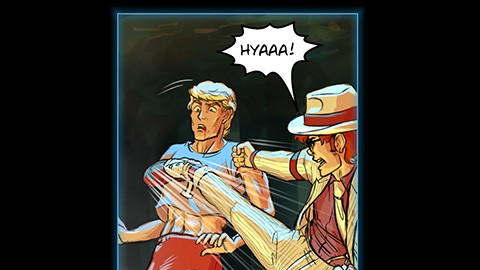
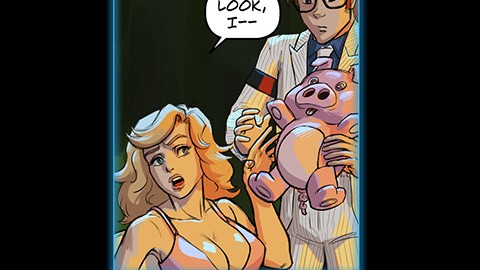
Sorry about the two week delay due to Jessica's pissed off pancreas and assorted holiday shenanigans. Hopefully we can now get back to a page a week update schedule.
We'd hoped to give you the gift of the newest page today, but it's not done yet. Jessica's illness had sapped her artistic powers, and now that she's finally feeling better, we have all sorts of Holiday distractions.
Mega bummer, I know. But I have something to cheer you up: the 1985 He-Man & She-Ra Christmas special, in which Skeletor learns the meaning of Chistmas.
Looks like the next page is going to be a couple days late.
Jessica was happily working on the page Thursday, when she developed a nasty stomach ache. It persisted overnight, preventing her from getting much sleep, so I took her to the Urgent Care Center. They looked her over, then had her go to the ER. After some more tests, they found out she has pancreatitis, basically an inflamed pancreas.
She's on painkillers and doing fine now. She just has to take it easy and stay on a liquid diet for a few days.
Anyway, we just wanted to give you a heads up on why the next page is going to be posted later than usual.
When Conan the Barbarian came out in 1982, it schooled us on what was best in life and introduced the world to one of the biggest icons of the ‘80s (and beyond). It also kickstarted the golden age of the barbarian movie genre. Unfortunately, none of the barbarian films that followed came close to matching the masterpiece that is Conan the Barbarian (including its own sequel), but a lot of them are awesome because of just how campy or fucking weird they are.
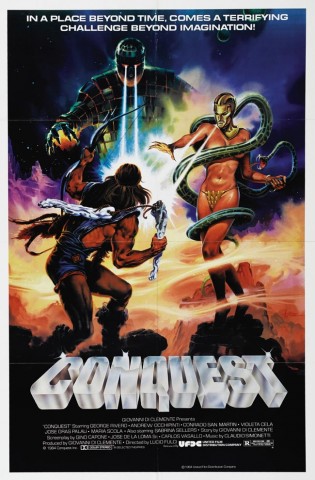
Take Conquest for instance. It’s definitely the most fucked-up of all the barbarian films I’ve seen, and that’s a genre with no shortage of fucked-upness. Conquest is sort of an odd mix between Conan the Barbarian, Quest for Fire (an awesome 1981 epic about Neanderthals and early humans which featured Ron Perlman in the role he was born to play), and one of John Boorman’s more surreal films, like Zardoz. Oh, and Conquest is directed by Lucio Fulci.

 January 3, 2015 - 3:50am by Adam Dravian